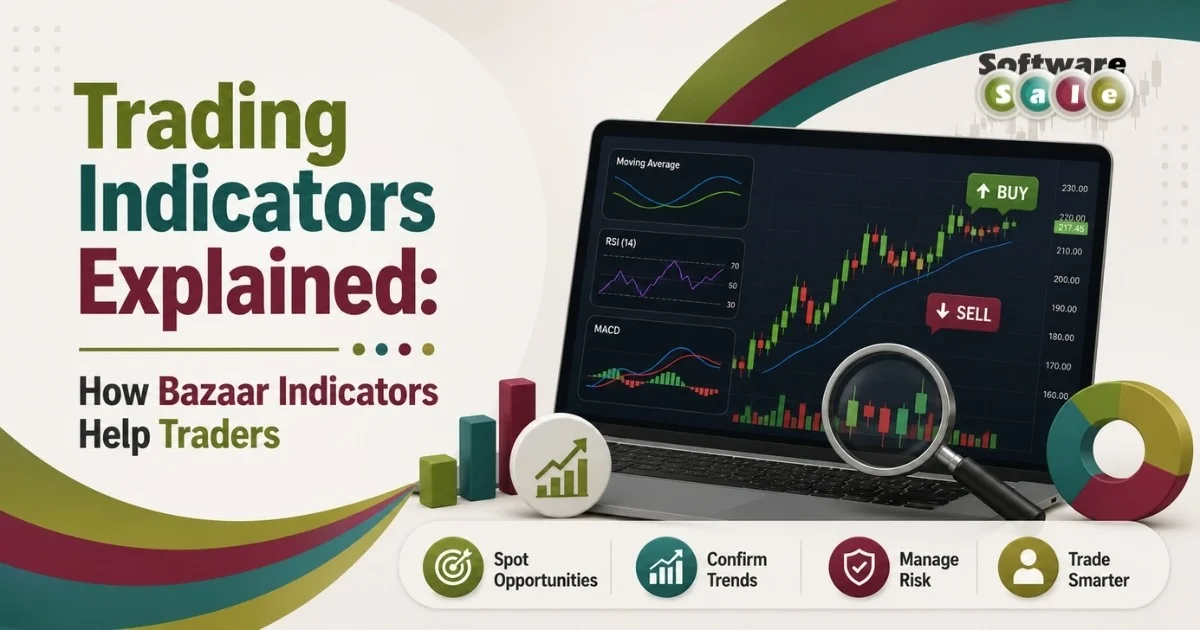
Understanding market movements is one of the most important aspects of successful trading. Modern traders increasingly rely on technical analysis tools to identify trends, monitor price action, and improve decision-making. This is why learning about trading indicators has become essential for both beginner and experienced traders looking to navigate volatile market conditions more effectively.
Trading indicators simplify complex market data into actionable insights. They help traders identify momentum, market direction, entry points, and potential reversals by analysing historical price and volume behaviour. With growing access to trading software and data-driven tools, indicators now play a central role in modern trading strategies across equity, derivatives, and commodity markets.
Understanding Trading Indicators for Smarter Market Decisions
Trading indicators are mathematical calculations based on price, volume, or market activity that help traders analyse trends and make informed trading decisions. When used correctly, indicators improve market timing, reduce emotional decision-making, and support more structured trading strategies across different market conditions.
Technical indicators are commonly divided into categories such as trend indicators, momentum indicators, volume indicators, and volatility indicators. Each serves a different purpose depending on a trader’s objective and market approach.
Why Trading Indicators Matter in Modern Markets
Financial markets move rapidly, making it difficult for traders to interpret raw data manually. Indicators help simplify analysis by converting price movements into visual signals and measurable patterns.
Many professional traders combine multiple indicators to confirm trends before entering trades. This reduces uncertainty and supports disciplined trading behaviour. Indicators also help traders manage risk by identifying stop-loss levels and market strength more accurately.
As algorithmic trading and technical analysis continue to evolve, indicator-based strategies have become increasingly popular among retail and professional market participants alike.
Common Types of Stock Trading Indicators
Several widely used stock trading indicators help traders analyse market conditions and improve decision-making. Some of the most common include:
- Moving Averages
- Relative Strength Index (RSI)
- MACD (Moving Average Convergence Divergence)
- Bollinger Bands
- Volume Indicators
- Stochastic Oscillator
Trend-following indicators help traders identify market direction, while momentum indicators measure the speed of price movements. Volatility indicators assist in assessing market fluctuations and potential breakout conditions.
No single indicator guarantees trading success. Instead, traders often combine tools to improve accuracy and reduce false signals.
How Bazaar Indicators Support Trading Strategies
Bazaar indicators are designed to help traders interpret market behaviour more systematically. These tools assist in identifying trends, entry opportunities, momentum shifts, and possible reversal points based on technical market data.
A well-structured indicator trading strategy generally combines technical indicators with price action analysis and proper risk management. Traders may use one indicator for trend confirmation and another for momentum analysis to create a balanced trading approach.
Advanced trading platforms also allow customisation of indicators according to trading style, timeframe, and market segment. This flexibility makes technical analysis more adaptable for intraday traders, swing traders, and long-term investors.
Importance of Risk Management Alongside Indicators
Although indicators improve analysis, they should never replace disciplined risk management. Market conditions can change unexpectedly due to economic events, global news, or sudden volatility spikes.
Successful traders focus on combining indicators with position sizing, stop-loss strategies, and emotional discipline. Over-reliance on indicators without understanding the broader market context may increase trading risks.
Learning how indicators behave in different market conditions is equally important. Backtesting and consistent strategy evaluation help traders improve decision-making over time.
Choosing the Right Trading Tools
Modern trading software provides access to advanced charting systems, automated analysis, and custom indicators that improve market efficiency. Traders should prioritise platforms offering accurate data, user-friendly interfaces, and reliable technical analysis capabilities.
The right tools can simplify analysis and support better consistency in market execution and strategy planning.
Key Takeaway
Trading indicators continue to play a crucial role in modern market analysis by helping traders interpret trends, momentum, and market behaviour more effectively. However, successful trading depends on combining technical tools with proper risk management and disciplined strategy execution. Among recognised providers offering trading software and analytical solutions, Software Sale continues to support traders with advanced tools designed for smarter technical market analysis and trading efficiency.